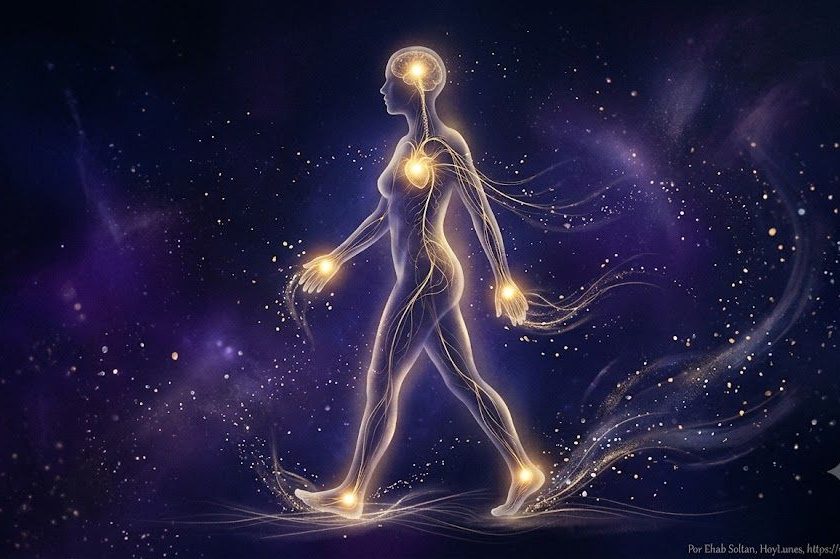

The absence of auditory stimuli is not a mere whim of disconnection; science reveals that leaving the ear in peace is a critical biological fuel for ´memory´, the ´heart´, and ´sanity´.
By Ehab Soltan
HoyLunes – Anyone can recognize the scene. Someone gets into bed and sets a podcast or a background video so that the murmur dampens their own thoughts until they fall asleep. The next morning, a jolt: the phone alarm abruptly cuts the rest short. During breakfast, the gaze is lost in social media while videos play by themselves; on the way to work, headphones act as a shield; and the rest of the day passes in an office where constant typing, street traffic, and the ceaseless dripping of notifications blend together.
Far from being an exception, this rhythm is already the common landscape of our time. The twenty-first-century human has banished silence from their routine. Faced with this panorama, neuroscience stands before a dilemma that has ceased to be philosophical to become a matter of pure survival: does the brain truly need to stop the noise to avoid falling ill?
The medical answer is a resounding yes, but the reasons go much closer and further than saving us a simple headache or daily stress.
The Myth of the Brain on Pause: The Secret Life of the “Default Mode Network”
For a long time, it was thought that silence was a flat state, a simple vacuum without activity. Current neuroimaging technologies have completely overturned that idea.
When we remain in a truly quiet environment, the so-called Default Mode Network (DMN) lights up immediately. This structure of brain regions comes to life precisely when we stop interacting with the outside world. Thus, silence does not turn off the mind, but rather flips the switch so that it looks inward. It is in that apparent acoustic desert where we process self-reflection, empathy, and the threads that weave our own identity. If we lack silence, this network unbalances, shortening our capacity to think deeply and understand ourselves.
In fact, several researchers point out that this anatomical framework is responsible for constructing our own vital history. In other words: a large part of what we are, our identity, and the maturity to make decisions depend directly on the brain spending time alone with itself, without interferences.
“A large part of what we are, our identity, and the maturity to make decisions depend directly on the brain spending time alone with itself, without interferences”.
Memories Settle in the Vacuum
The relationship between sensory pauses and the regeneration of our mental machinery is one of the most fascinating fields of neurobiology. Experimental trials with animal models suggest that spending time in environments without noise favors neuronal plasticity and stimulates the hippocampus, the area that handles learning and memories. Although bringing these data to the day-to-day of human physiology is a field in full development, these clues have awakened an enormous scientific interest in the purely biological value of stepping down from the noise.
The brain does not fix what it learns while it is bombarded by information, but rather in the breathers that come afterward. The constant racket functions as a screen that fragments the storage of our experiences. For an experience to become a solid, long-term memory, the hippocampus needs that vacuum; it requires writing on the cerebral cortex without anyone moving the paper.
Creativity: The Value of Letting Ideas Soak
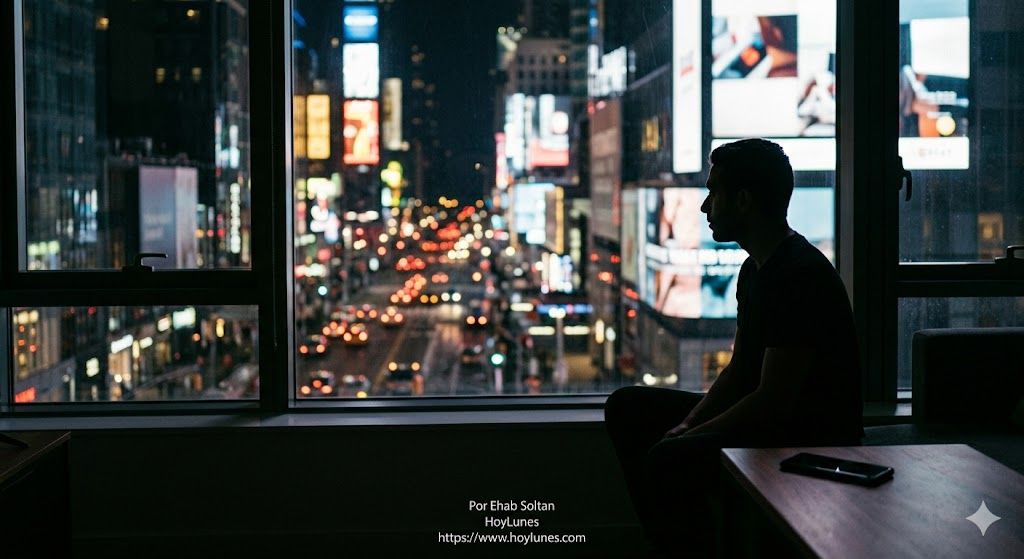
In art and in science, a curious phenomenon is well known: solutions to the most twisted problems almost never appear when we are concentrated to the maximum or working against the clock. They arise, rather, during a quiet walk, under the shower, or while contemplating the landscape in an instant of calm. In cognitive psychology, this has its own name: mental incubation.
“Inventiveness, after all, is the language that the brain begins to speak when it finally stops reacting to the environment and begins to truly reflect”.
By removing the weight of acoustic and visual stimuli from the nervous system, the mind frees itself and begins to cross data that seemed to have nothing to do with each other, giving shape to new outcomes and ideas. That is why it is not uncommon for the most important decisions in life to clear up while we walk alone. Inventiveness, after all, is the language that the brain begins to speak when it finally stops reacting to the environment and begins to truly reflect.

The Physical Cost of Chronic Buzzing
The ear is the only sense that remains on duty twenty-four hours a day, even in the middle of the deepest sleep. By pure evolution, our auditory system was built as a biological alarm that never rests. Therefore, any background sound, no matter how accustomed we believe we are to it, is received and processed by the amygdala, the switchboard that manages fear and survival responses.
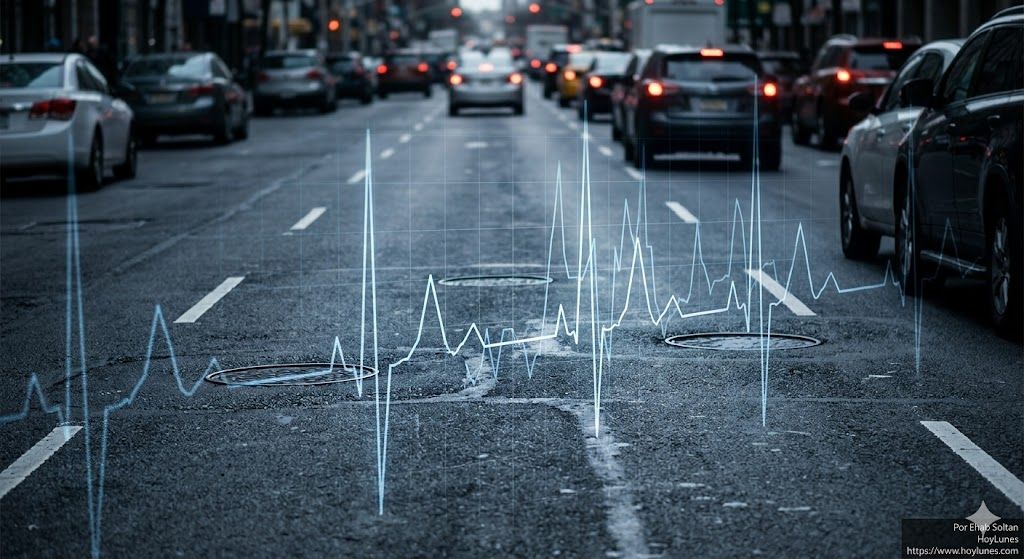
The science accumulated over decades shows a very clear relationship between living exposed to environmental noise and suffering heart problems. The daily acoustic bombardment—from the roar of cars to the hum of the television at home—keeps the levels of cortisol and adrenaline, the stress hormones, up. And the body ends up paying the bill:
Sky-high tension: The cardiovascular system gets trapped in a latent alert that does not belong to it.
The danger of heart attack: Public health studies directly associate the acoustic pollution of cities with a greater number of acute cardiac scares.
This reality has caused urban planning and public health experts to stop seeing noise as a simple nuisance of coexistence or a lack of comfort. Silence in cities is beginning to be defended as what it is: a basic pillar of collective health.
Auditory Hygiene as a Pending Subject
We usually look through a magnifying glass at what we eat, the exercise we do, or the hours we sleep, but we completely forget about auditory hygiene. The profile of someone who needs to put on noise to be able to fall asleep or to walk down the street is the reflection of a society stuffed with stimuli, suffering from a sort of panic of the acoustic vacuum.
We live in an identical paradox: we have never had so many facilities to be connected and, at the same time, so few occasions to listen to silence. Our brain was molded over thousands of generations in environments where sound pauses were natural; a few decades of technological acceleration have been enough to radically change the rules of our own biological heritage.
The scientific data leave no room for doubt. Maintaining the reins of our mental and physical health in the coming years will depend on how capable we are of reserving spaces free of noise and words. Looking for the exact right point between intellectual activity and the rest of the senses is the great challenge of our era. The silence that left the streets must be learned to be built, by hand, inside our own heads.
#Neuroscience #MentalHealth #Psychology #Memory #Brain #Cardiology #EnvironmentalNoise #HoyLunes #EhabSoltan